Your Website is a Leaking Bucket, and Speed is the Only Plug
Stop obsessing over your hero image. It doesn't matter if your copy was written by a legend if the page hasn't loaded by the time a CEO clicks "Back." In March 2026, speed isn't a technical metric. It is your closing argument. If you are a B2B provider selling high-ticket services, a slow site screams "amateur." You lose authority before the first pixel of your logo appears. We are talking about a world where 0.6 seconds is the new gold standard. Anything slower is a bounce. Mastering the Best website speed optimization 2026 is the only way to survive a market where decision-makers have the attention span of a fruit fly and the budget of a small nation.
Your site is bleeding money. While you’re busy pixel-peeping that hero image or debating font weights with a designer, your high-value prospects are already hitting
Deploy the AbdulTSD Protocol
We don't just write about Web Development; we build the infrastructure that dominates it. Choose a unit to start.
 Developer reviewing code monitor
What is Best website speed optimization 2026?
When we define Best website speed optimization 2026, we aren't talking about compressing a few JPEGs or installing a caching plugin on a $10-a-month shared hosting plan. That is 2018 thinking. In 2026, optimization means "Zero Latency Architecture." It is the shift from monolithic CMS platforms like traditional WordPress to headless, edge-cached environments. It means your site exists everywhere at once, served from the nearest CDN node to the user, rather than a single server in a basement in Northern Virginia.
Automate Your Growth with Industry-Standard Tools
Stop using limited trials. Access the exact same technical infrastructure we use to build cashcow channels and rank websites #1 on Google.
It is the science of reducing the "Time to Interactive" (TTI) to under 600 milliseconds. This involves stripping away every unnecessary byte. It means using modern frameworks like Astro or Next.js that prioritize server-side rendering and static site generation. But it also means a cultural shift. You have to stop letting your marketing team add every tracking script they find on a "Top 50 MarTech Tools" list. Every script is a weight. Every weight slows the sale.
How does Best website speed optimization 2026 work?
Understanding how Best website speed optimization 2026 works requires a look under the hood of modern web engineering. It starts with the "Edge." Instead of a user's browser asking a server for data, the data is already waiting for them at the edge of the network. Tools like Cloudflare Workers or Vercel Edge Functions execute code closer to the user. This eliminates the physical distance data has to travel. It is the difference between driving across town for groceries and having them already in your fridge.
But the real magic happens with "Predictive Prefetching." By March 2026, AI-driven scripts analyze user mouse movement. If a user hovers over your "Contact Us" button, the browser starts downloading that page in the background before they even click. By the time the finger hits the mouse, the page is ready. It feels like magic. It feels like quality. And for a B2B corporate service provider, that feeling of "instant" translates directly to a feeling of "competence."
We also see a massive move toward "Binary Image Formats." Forget WebP. We are now using AVIF and even newer formats that offer 50% better compression without losing a single pixel of detail. And we are doing it dynamically. Your site should detect if a user is on a 5G connection in London or a spotty Wi-Fi in a rural area and serve the appropriate asset size automatically. No more one-size-fits-all images. Server rack with glowing blue lights
Why is Best website speed optimization 2026 important?
This is why Best website speed optimization 2026 is important for your bottom line: Trust is built on reliability. If your site is fast, you look like a leader. If it is slow, you look like a relic. Corporate decision-makers are under immense pressure. They don't have time to wait for your "About Us" page to load its 4MB background video. They want answers. They want them now. And if you don't provide them, your competitor—who invested in a high-performance stack—will.
But there is a deeper reason. Search engines have moved beyond simple keywords. In 2026, Google’s "Experience Signals" are the primary ranking factor. If users bounce from your site because it is slow, your rankings will tank. It doesn't matter how many backlinks you have. If the user experience is trash, you are invisible. Speed is the foundation of your entire digital presence. Without it, your SEO, your PPC, and your content marketing are all built on sand.
The Hard Truth About Your "Pretty" Website
Your design agency is lying to you. They want to sell you a "visual experience" filled with parallax scrolling, heavy animations, and high-resolution video backgrounds. Why? Because it looks great in a portfolio. But it is a disaster for your conversion rate. Most design-heavy sites are technical nightmares. They are built on top of bloated themes with 40 different CSS files and 20 JavaScript libraries that all fight for dominance while the user waits.
The hard truth is that ignoring the Best website speed optimization 2026 standards is a form of professional negligence. You are literally throwing away leads. I have seen B2B firms spend $50,000 on a redesign only to see their lead volume drop by 30% because the new site took 4 seconds to load on a mobile device. Stop prioritizing "pretty" over "performant." A fast, clean, functional site will out-convert a slow, flashy site every single time. If you want to see what works, look at our case studies to see how performance-first architecture wins.
And let's talk about WordPress. If you are still using a "drag-and-drop" page builder like Elementor or Divi in 2026, you are handicapping yourself. These tools inject massive amounts of "code bloat" into every page. They are great for hobbyists. They are poison for corporate service providers. If you want 0.6s speeds, you need clean, hand-coded components or a highly optimized headless setup. There are no shortcuts.
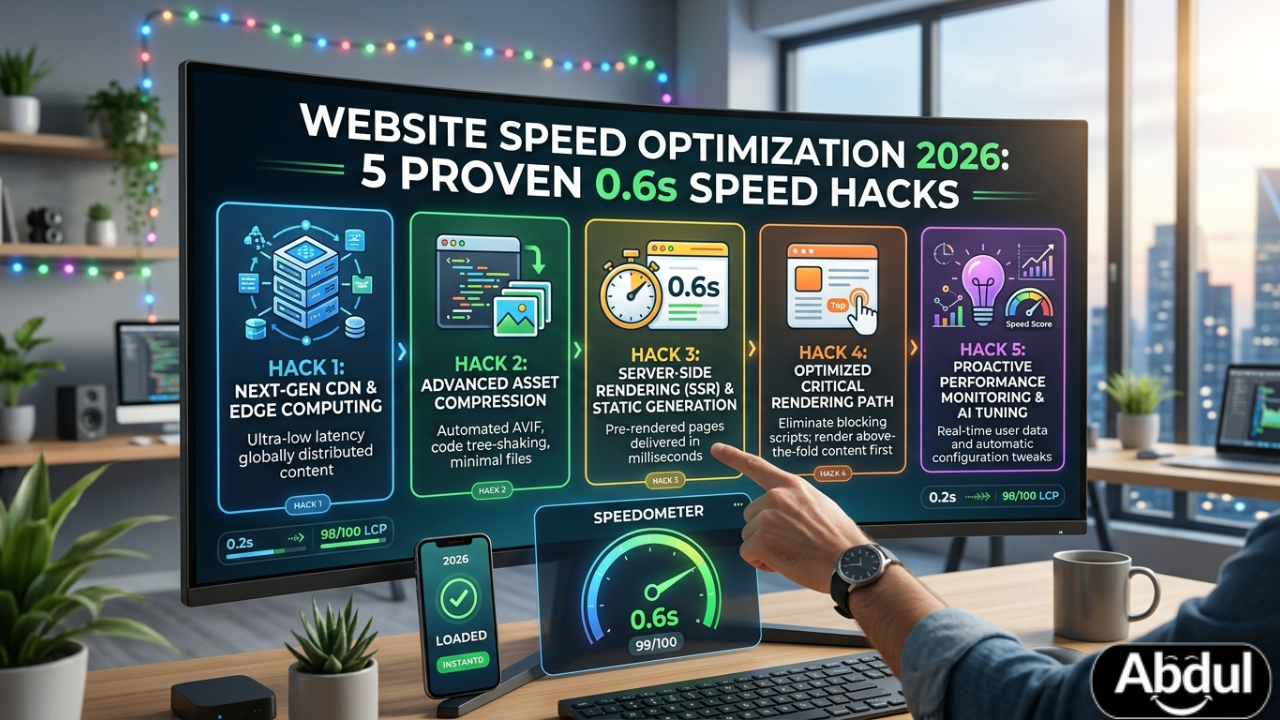
5 Proven 0.6s Hacks for 2026
If you want to hit that elusive 0.6s load time, you need to stop tweaking and start transforming. Here are five hacks that actually move the needle in the current environment.
1. Kill the Third-Party Script Bloat
Check your Google Tag Manager. You probably have tracking pixels for platforms you haven't used in three years. Each one of those scripts requires a DNS lookup and a handshake. They block the main thread. Audit them ruthlessly. If a script isn't providing actionable data that leads to revenue, delete it. Use "Partytown" to run necessary scripts in a web worker, keeping them off the main thread so they don't slow down the user's interaction.
2. Move to a Headless CMS
Stop making your server generate HTML every time someone visits a page. Use a headless CMS like Contentful or Sanity paired with a static site generator. This allows you to pre-build your entire site into flat HTML files. When a user visits, there is no database query. There is no PHP processing. There is just a file being served instantly from a CDN. This is the core of Best website speed optimization 2026.
3. Implement Font Subsetting
Most sites load an entire font library just to use three weights of one typeface. That is a waste of bandwidth. Use font subsetting to only include the characters you actually use. Better yet, use system fonts (Arial, Helvetica, Apple System) for your body text. They require zero download time because they are already on the user's device. Save the custom brand fonts for your headings only.
4. Use Edge-Side Includes (ESI)
For B2B sites that need some dynamic content (like a "Welcome back, [Name]" message), don't sacrifice speed for personalization. Use Edge-Side Includes. This allows the bulk of the page to be served as a static, cached file, while only the tiny dynamic parts are fetched at the edge. You get the speed of a static site with the power of a dynamic one.
5. Optimize Your CSS for the "Critical Path"
Stop loading a 200KB CSS file at the top of your page. Inline your "Critical CSS"—the styles needed to render the top of the page—directly into the HTML. Load the rest of the CSS asynchronously. This ensures the user sees a styled page almost instantly, while the rest of the design "fills in" a split second later. It’s about perceived speed as much as raw numbers.
"In the B2B world, speed is the ultimate proxy for quality. If you can't optimize your own website, why should a client trust you to optimize their business?"
The Next Step: Audit or Die
You cannot fix what you do not measure. Your first step is to run a deep-dive technical audit. Don't just look at the surface-level metrics. Look at your server response times, your script execution order, and your asset delivery pipeline. If you aren't hitting that 0.6s mark, you are leaving money on the table. The market in 2026 does not forgive slow sites. It ignores them.
Start by using our Free SEO Audit Tool to get a baseline of where you stand. Once you have the data, be ruthless. Fire the slow plugins. Fire the bloated themes. If necessary, fire the agency that told you a 3-second load time was "fine." It isn't fine. It's a failure. Your website is your best salesperson, but only if it actually shows up to the meeting on time. Make it fast, make it instant, and watch your conversion rates finally reflect the quality of your service.
Unlock Your Digital Potential
Complimentary tools designed to accelerate your growth.