
What is Generative Engine Optimization 2026? Essential E-E-A-T 2.0
The digital marketing world, as you knew it, is dead. Forget the endless keyword stuffing, the race for the #1 organic spot that barely registers a click anymore. We're in March 2026, and the game has fundamentally shifted. Google's Search Generative Experience (SGE) isn't just a new feature; it's a complete paradigm shift. Microsoft Copilot's 'Answer Box' dominates B2B queries. Your brand’s survival now hinges on a single, brutal truth: you must be the *cited source* in AI-generated answers, not just a link on a fading SERP. This isn't about optimizing for algorithms; it's about optimizing for intelligence.📊 Data Point: Research on 'What is Generative Engine Optimization 2026?' shows growing importance in the Beyond Keywords: Why Your Brand Needs Generative Engine Optimization (GEO) in 2026 space. This isn't a trend; it's the new baseline.
This article cuts through the noise. We're going beyond keywords to explain why your brand needs Generative Engine Optimization (GEO) in 2026. I'll show you how to stop wasting budget on outdated SEO tactics and start building the authority AI models crave. This is E-E-A-T 2.0, stripped down and actionable.
Defining Generative Engine Optimization: The AI-First Approach
So, what is Generative Engine Optimization 2026? It's the strategic process of optimizing your digital content and technical infrastructure to be understood, trusted, and cited by AI search models and generative AI platforms. Think of it less as SEO and more as "Source Authority Optimization." The goal isn't to rank a page; it's to ensure your brand's expertise is the definitive answer when an AI assistant responds to a user query. When a user asks Google SGE, "What's the best CRM for small businesses with under 20 employees?", the AI doesn't just list ten links. It synthesizes information, often providing a concise, direct answer, complete with attributed sources. Your brand needs to be one of those sources. This means moving beyond simple keyword matching to deep semantic understanding, contextual relevance, and undeniable authority. It's about building content that an AI can confidently "learn" from and then "teach" to its users. Imagine a mid-sized SaaS company, "CloudFlow," offering project management software. In the old world, they'd target "best project management software." Now, with Generative Engine Optimization 2026, they're optimizing for specific feature comparisons, integration guides (e.g., "CloudFlow vs. Asana for agile teams"), and problem-solution scenarios ("How CloudFlow streamlines client onboarding for marketing agencies"). Their content isn't just for human readers; it's meticulously structured for AI consumption, ensuring their platform is cited as the expert solution in generative summaries. AI search results snippet
How Generative Engine Optimization Works: Building AI Trust
Generative Engine Optimization isn't magic. It's a systematic approach to content creation and technical implementation that makes your website "AI-readable." This means focusing on several key areas, all under the umbrella of E-E-A-T 2.0: Experience, Expertise, Authoritativeness, Trustworthiness, and now, *Explainability* and *Engagement*. First, content must demonstrate genuine *Experience* and *Expertise*. This isn't about ghostwritten articles. It's about showcasing real-world knowledge. If you're writing about Kubernetes deployments, the author needs to be a DevOps engineer with a GitHub profile showing actual contributions. For a financial planning firm, their advisors' credentials and published research become paramount. Second, *Authoritativeness* and *Trustworthiness* are amplified by structured data. This is where technical SEO gets a serious upgrade. We're talking about comprehensive Schema Markup (JSON-LD) that explicitly tells AI models what your content is about, who created it, and why it's credible. Think about marking up your FAQs, how-to guides, product specifications, and even author bios with extreme precision. This isn't optional. It's foundational.💡 Pro Tip: Your website's technical schema is the direct communication channel to AI models. Our Full-Stack Development services prioritize implementing advanced technical schema that makes your content not just crawlable, but truly "AI-readable," ensuring your expertise is understood and cited.
Third, *Explainability* means your content is clear, concise, and easy for an AI to summarize and extract facts from. Break down complex topics into digestible sections. Use clear headings, bullet points, and definitive statements. Avoid jargon where simpler terms suffice. *Engagement* means your content holds attention and encourages further exploration, even if that exploration starts with an AI summary. This could be through interactive elements, compelling visuals, or a natural flow that guides the AI (and human) through your expertise.
Consider an e-commerce brand specializing in high-end camera equipment. Their product pages and buying guides aren't just descriptions. They include detailed specifications marked with Schema.org, expert reviews from professional photographers (with their portfolios linked), and comparison charts that AI can easily parse. When a user asks Copilot, "What's the best mirrorless camera for wildlife photography under $3000?", the AI pulls data directly from their meticulously structured content, citing the brand as the authoritative source. This is how Generative Engine Optimization 2026 delivers real value.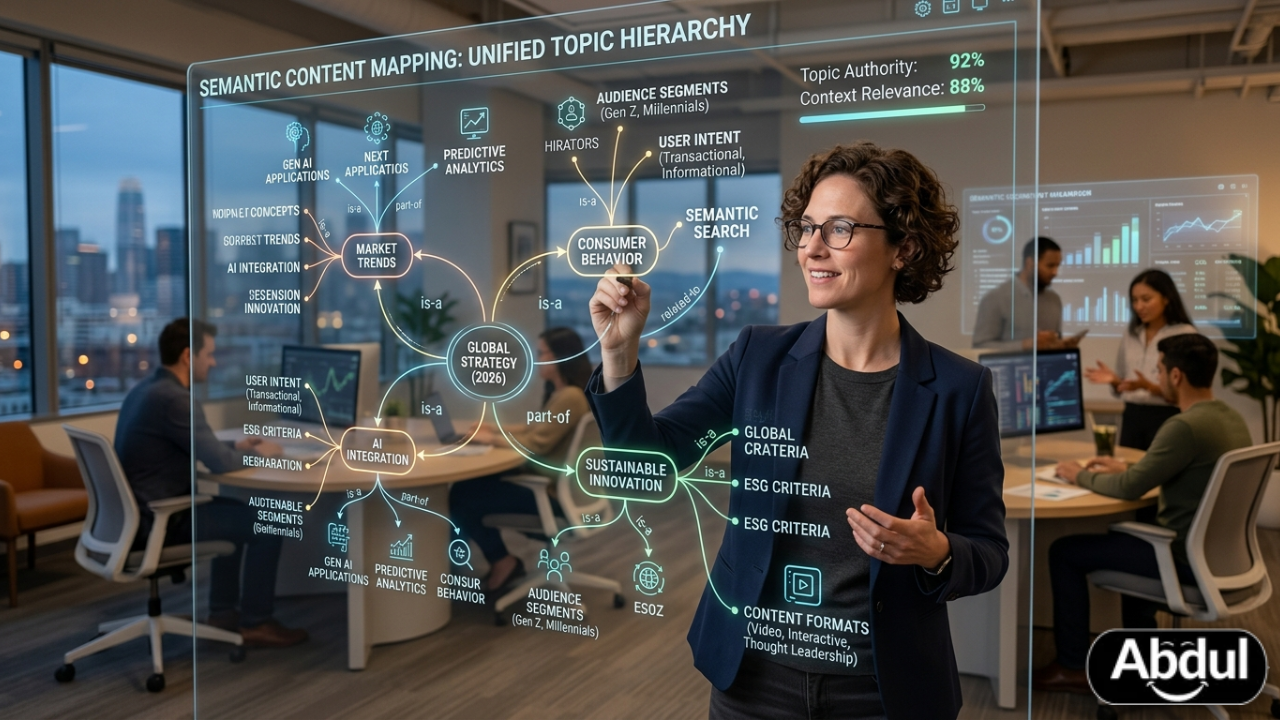 Semantic content mapping
Why Generative Engine Optimization is Your Brand's Lifeline in 2026
The importance of Generative Engine Optimization 2026 can't be overstated. Your brand's visibility, reputation, and ultimately, its revenue, depend on it. Ranking #1 on a traditional SERP is increasingly irrelevant when users get their answers directly from an AI. If your brand isn't cited in that AI answer, you simply don't exist in the user's immediate consideration set. Being a cited source in AI answers builds unparalleled brand trust. Users inherently trust the information presented by AI assistants, especially when sources are clearly attributed. This direct attribution bypasses the traditional click-through model, placing your brand directly into the user's consciousness as an authority. This is critical for B2B marketing, where Microsoft Copilot's 'Answer Box' is rapidly becoming the primary information gateway for decision-makers. If your competitor is consistently cited for industry insights or product comparisons, you're losing mindshare before the sales funnel even begins. Think about a local roofing contractor. In the past, they'd optimize for "roof repair [city name]." Now, with Generative Engine Optimization, they're creating detailed, expert content on "signs of roof damage after a storm," "understanding different roofing materials," or "how to choose a reliable roofing contractor." This content, rich with local context and expert advice, is structured for AI. When a homeowner asks SGE, "What should I do if my roof leaks after heavy rain?", the AI provides steps, and then, crucially, cites the local contractor's guide as a trusted resource. This isn't just traffic; it's qualified leads built on trust and authority. This shift isn't just about search; it's about the future of information consumption. As AI assistants become more integrated into our daily lives – from smart speakers to enterprise software – being the definitive source means being omnipresent. It means your brand is the answer, not just a link. Brand trust metrics dashboard
The Hard Truth About E-E-A-T 2.0 and AI-Readiness
Let's be blunt: most brands are failing at Generative Engine Optimization 2026 because they're still stuck in 2016. They're chasing keyword density and link counts like it's still the wild west of SEO. Stop doing that. It's a waste of time, money, and developer cycles. Google's SGE 'Source Authority' Update in Q2 2026 hammered this home: generic, thin content, even if it "ranks," will never be a cited source. The biggest misconception is treating AI as just another algorithm to trick. It's not. AI models are designed to understand, synthesize, and evaluate information much like a human expert. They prioritize genuine expertise, verifiable facts, and clear, well-structured explanations. If your content is shallow, contradictory, or lacks real-world authority, AI will ignore it. Period.⚠️ Common Mistake: Relying on AI-generated content without human oversight and expert input. AI can assist, but it cannot *be* the expert. Content needs a human touch, real experience, and verifiable facts to satisfy E-E-A-T 2.0.
Many teams overcomplicate the basics. They focus on obscure technical tweaks while neglecting the core: creating truly exceptional content. When an enterprise B2B company needs to explain a complex data analytics platform, a 500-word blog post full of buzzwords won't cut it for Copilot's answer box. You need deep, structured documentation, comprehensive whitepapers, and case studies that demonstrate real-world impact. This content needs to be meticulously organized, internally linked, and authored by recognized experts within the field. It's about proving your authority, not just claiming it.
This isn't just about content, either. Your website's underlying architecture matters. If your site is slow, riddled with technical errors, or difficult for crawlers to parse, AI models will struggle to extract value. A robust, well-maintained site is a prerequisite. This is why investing in solid technical SEO audits and development is non-negotiable.
Your Quick Checklist for Generative Engine Optimization
Ready to pivot your strategy and embrace Generative Engine Optimization 2026? Here’s a quick, actionable checklist to get started:- Audit Your Content for E-E-A-T 2.0: Review existing content. Does it showcase genuine experience and expertise? Is the author clearly identified and credible? Is it trustworthy and authoritative? Can an AI easily explain and summarize it? Does it engage?
- Implement Advanced Schema Markup: Go beyond basic Schema. Use specific types like `HowTo`, `FAQPage`, `Product`, `Article`, and `Person` to explicitly define your content and authors for AI.
- Prioritize Semantic Content Clusters: Instead of isolated articles, build comprehensive content hubs around core topics. Interlink extensively. Show AI the depth of your knowledge.
- Focus on Problem-Solution Content: AI users ask questions to solve problems. Create content that directly addresses specific user pain points with clear, actionable solutions.
- Verify Author Credibility: Ensure every piece of expert content is attributed to a real person with verifiable credentials. Link to their professional profiles (LinkedIn, GitHub, academic papers).
- Optimize for AI Summarization: Use clear headings, concise paragraphs, and bullet points. Ensure key takeaways are easily identifiable.
- Monitor AI Answer Box Presence: Track which of your content pieces are being cited in Google SGE and Microsoft Copilot. Adjust your strategy based on what's working.
- Invest in Technical Foundation: A fast, secure, and error-free website is non-negotiable. AI models prioritize sites that are easy to crawl and understand.
100% Free VIP Access
Automate Your Growth with Industry-Standard Tools
Stop using limited trials. Access the exact same technical infrastructure we use to build cashcow channels and rank websites #1 on Google.
Technical SEO Audit
AI CV Architect
Cashcow Automation
AI Brand Suite
Technology Growth Units
Deploy the AbdulTSD Protocol
We don't just write about Technology; we build the infrastructure that dominates it. Choose a unit to start.
Topics:
generative engine optimization
E-E-A-T 2.0
Google SGE
AI SEO
future of digital marketing
SEO 2026
Copilot marketing
Unlock Your Digital Potential
Complimentary tools designed to accelerate your growth.